 NATALIJA HAYTERPSYCHOTHERAPY & COUNSELLING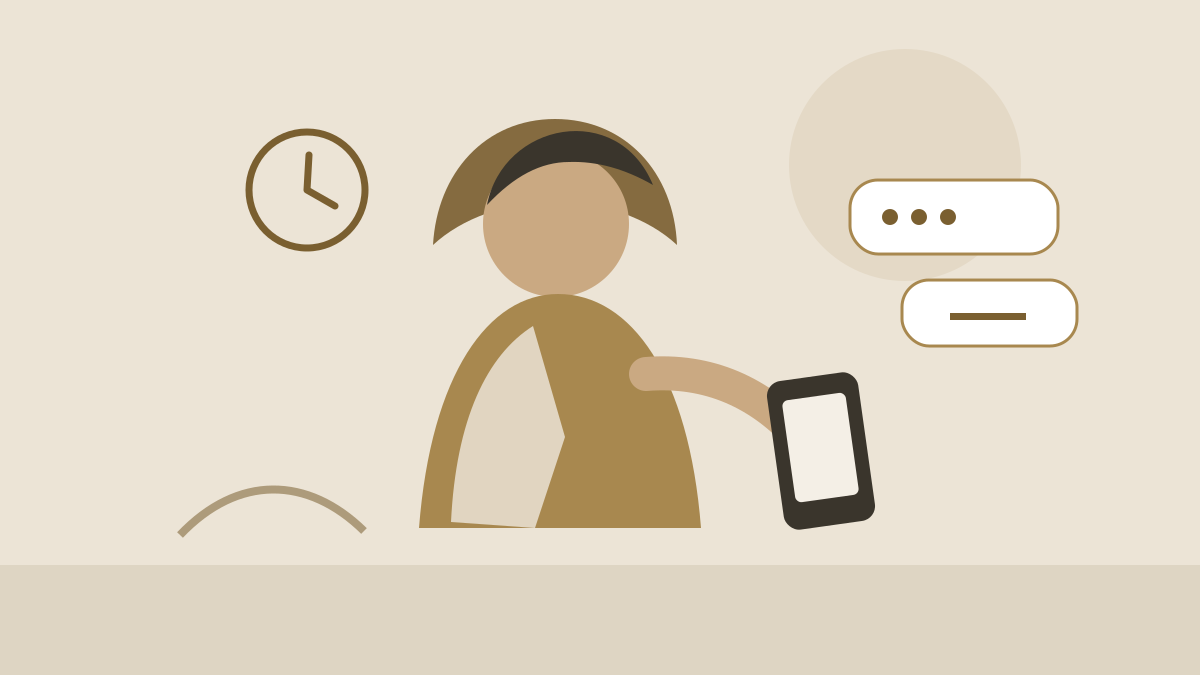
You check your phone for the fourth time in ten minutes. They have not replied. Your chest tightens. Your mind starts building a case: they are pulling away; I have done something wrong; this is how it always ends. Nothing has actually happened yet — and you are already grieving.
If this is familiar, you are not “too much”, and you are not broken. Fear of abandonment is a painful pattern in which the possibility of rejection, separation or loss feels unusually urgent. Psychology and neuroscience can help us understand parts of that pattern, although there is no single brain scan or childhood story that explains every person. Most importantly, patterns of relating can change.
What fear of abandonment actually feels like
It rarely announces itself simply as fear. Common signs of fear of abandonment can include:
- a stomach-drop when a message goes unanswered for longer than expected;
- replaying a conversation for hours, searching for the moment you were “too much”;
- feeling calm one hour and desperate the next after an ambiguous relational cue;
- ending or disrupting a relationship first, before the other person can do it;
- staying in a relationship that hurts because separation feels even more frightening.
Researchers often describe related patterns in terms of anxious attachment: heightened attention to possible rejection, a strong need for reassurance and difficulty feeling secure when connection seems uncertain. These are not character defects. They may be understandable strategies that developed in response to earlier relationships and are now being applied in a different context.
Why fear of abandonment develops
Attachment theory, developed by John Bowlby and extended by Mary Ainsworth, offers one useful framework. Children depend on caregivers for safety and regulation. When care is inconsistent, frightening, interrupted by loss, or emotionally difficult to predict, a child may become especially alert to signs that connection is at risk.
This does not require an obviously traumatic childhood, and inconsistent care does not predetermine an adult attachment style. A parent may have been loving but preoccupied, available in calm periods but withdrawn under stress, or affected by illness, bereavement, separation or their own difficulties. Temperament, later experiences and current relationships also matter. The point is not to assign blame, but to understand how a once-protective expectation may still be shaping the present.
What happens in the brain when you fear abandonment?
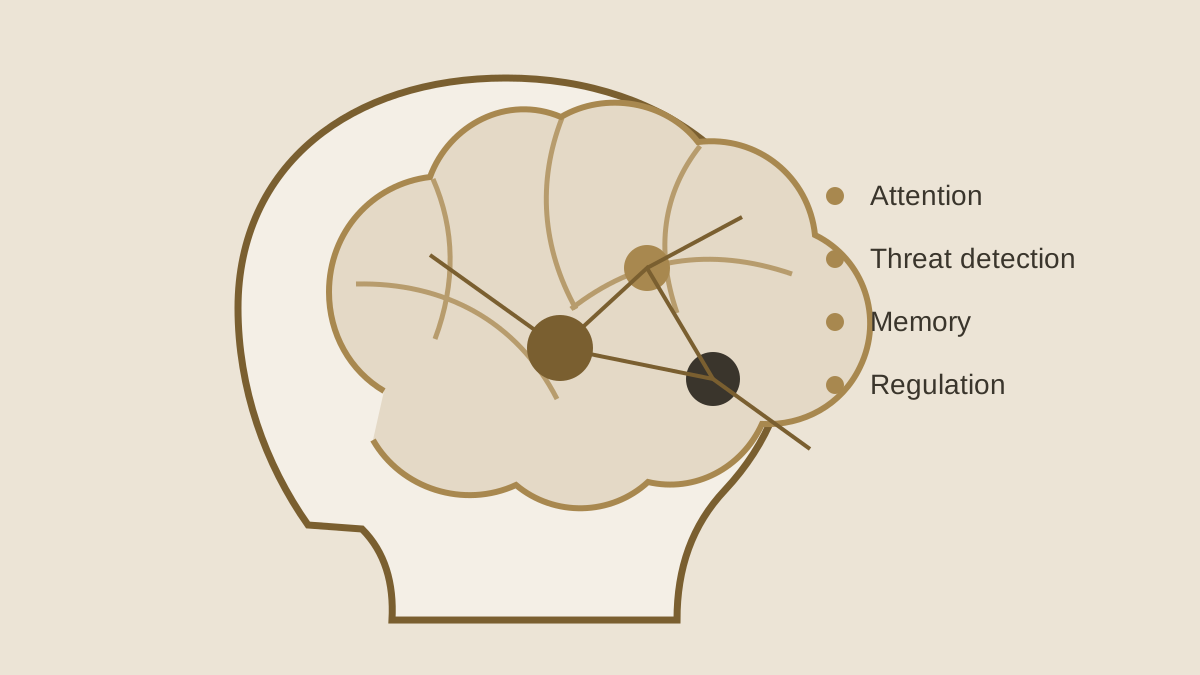
Social threat can engage some of the same broad systems involved in fear, distress and emotion regulation. In one small fMRI study, higher attachment anxiety was associated with stronger responses to imagined relationship loss in some emotion-related regions and lower recruitment of an orbitofrontal region involved in regulation. Studies of social rejection in people with borderline personality disorder have also found altered responses in networks involved in social interpretation and regulation.
In everyday terms, a delayed reply, flat tone of voice or distracted partner may be interpreted as a warning of disconnection. The body can then react with a racing heart, nausea, tension or sleeplessness. Research has found associations between attachment insecurity, emotion regulation and physical symptom reporting, but association does not prove a single cause. The experience is real even when the feared conclusion is not accurate.
How people cope with fear of abandonment — and why it can backfire
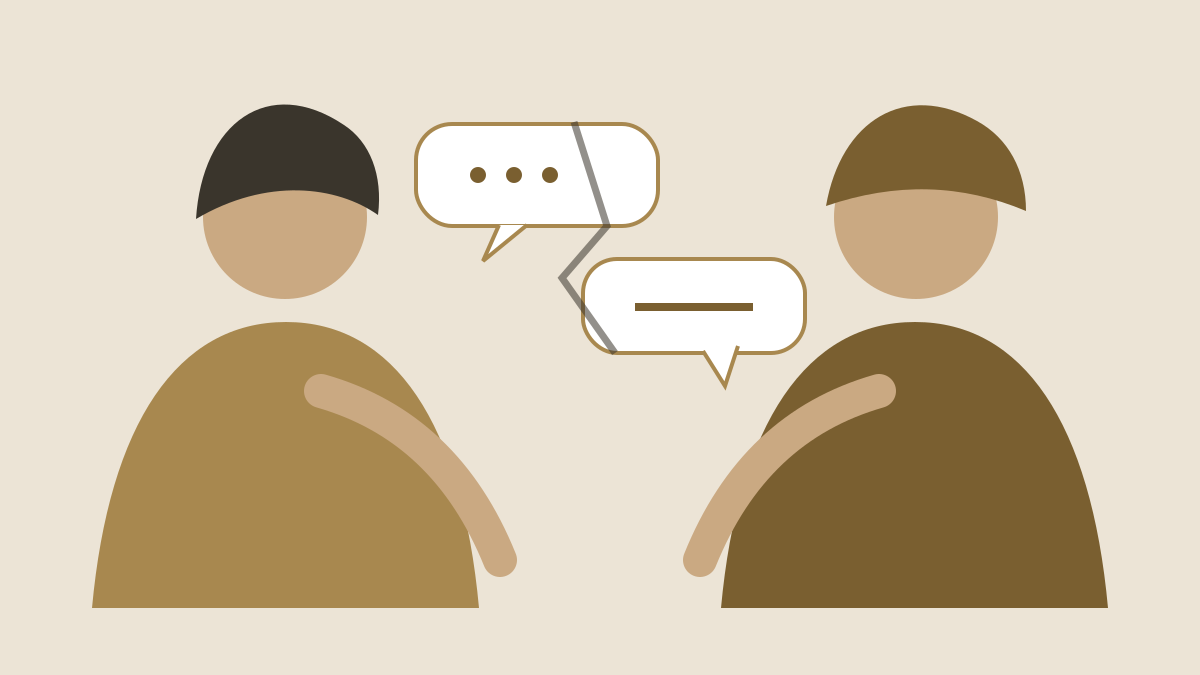
Nobody chooses these strategies in a vacuum. Each one has a protective function and may once have helped. Over time, however, it can create the distance it is trying to prevent.
Constant reassurance-seeking
Repeatedly asking “Are we okay?”, “Do you still love me?” or “Are you upset with me?” can bring immediate relief. Because the relief fades quickly, the next wave of uncertainty may prompt more checking. A partner can begin to feel monitored or responsible for regulating the fear.
Fawning and self-abandonment
Agreeing, accommodating and suppressing your own needs in order to prevent conflict is often called the fawn response. The term is widely used in trauma-informed therapy, although it is not a formal diagnosis. What can look like effortless kindness may sometimes be driven by a painful belief that being loved requires disappearing.
Difficulty letting go
Ending a relationship can feel emotionally identical to being abandoned. From the outside, staying may look inexplicable; from the inside, separation is registered as the greater danger. If a relationship is abusive or unsafe, the priority is safety and specialist support — not practising tolerance inside the harmful situation.
Testing, pushing away and over-functioning
Picking fights, withdrawing before the other person can, becoming indispensable, or anticipating every need can all offer a sense of control. So can moving very quickly and merging identities early in a relationship. Each strategy tries to secure connection, but may leave less room for mutuality, trust and honest difference.
Presentations that often go unrecognised
- In friendships: over-apologising, assuming silence means anger, or struggling to set healthy boundaries.
- At work: treating ambiguous feedback as rejection, overworking to avoid becoming “replaceable”, or finding a busy manager’s silence hard to tolerate.
- In parenting: intense guilt around normal separations, or difficulty tolerating a child’s growing independence.
- In therapy: anxiety around breaks and holidays, difficulty ending sessions, or testing whether the therapist will remain engaged after disagreement.
How to begin healing fear of abandonment

Recovery does not start with telling yourself to stop feeling afraid. It starts by treating the fear as information rather than proof, and gradually learning that connection can survive distance, disagreement and repair.
- Name the pattern without judgement. “This may be my abandonment fear speaking” creates a small but important gap between feeling and reacting. This is a useful CBT move: separating an automatic prediction from the available evidence.
- Track the function, not only the behaviour. Before trying to stop reassurance-seeking, fawning or clinging, ask what the behaviour is protecting you from in that moment.
- Practise tolerating manageable uncertainty. Pause briefly before checking again, or sit with an ambiguous but ordinary message before seeking reassurance. This is not appropriate where there is genuine danger, abuse or a serious reason for concern.
- Build a relationship with yourself that does not depend on anyone staying. Journalling, values work, supportive routines and reconnecting with interests can help shift self-worth away from being entirely externally regulated.
- Become curious about the origin story. Psychodynamic and attachment-informed work can explore when the fear formed, what it expects, and whose earlier responses it may still anticipate.
- Consider therapy. Fear of abandonment can involve both present-day interpretations and older relational expectations. Therapy may combine CBT experiments and emotional-regulation skills with careful exploration of attachment and relationship patterns.
A meta-analysis of 36 psychotherapy studies found that greater attachment security before treatment was associated with better outcomes, while improvements in security during therapy tended to coincide with improvement. That does not prove one therapy is best for everyone, but it supports the possibility that attachment-related patterns are not fixed.
Frequently asked questions
What are the signs of fear of abandonment?
Common signs include frequent reassurance-seeking, difficulty trusting reassurance, intense distress over delayed replies, people-pleasing, staying in relationships that hurt, or pushing others away before they can leave. A sign is not a diagnosis; context and impact matter.
Is fear of abandonment a diagnosable condition?
Fear of abandonment is not a diagnosis by itself. It may occur alongside anxious attachment or several mental-health difficulties, and it can also be present without meeting the criteria for any disorder. A clinician should assess the whole picture rather than infer a diagnosis from one experience.
Can fear of abandonment be healed?
Patterns can change. Therapy can help you understand the origins and triggers of the fear, test present-day predictions, develop emotional regulation, and experience safer ways of relating over time. Progress is usually gradual rather than a single moment of insight.
The part nobody wants to hear
You cannot reason or avoid your way out of every abandonment fear. Reassurance-seeking, fawning, staying and pushing away can postpone the discomfort without resolving it. The way through is usually gradual: meeting uncertainty in small, survivable doses until experience begins to show that distance, disagreement or even a departure can be painful without erasing your sense of self.
The goal is not a life entirely free of fear. It is a life in which fear no longer makes every relational decision for you.
Selected evidence
- Bowlby J. Attachment and Loss: Retrospect and Prospect, American Journal of Orthopsychiatry (1982).
- Gillath O et al. Attachment-style differences in suppressing negative thoughts: neural correlates, NeuroImage (2005).
- Domsalla M et al. Cerebral processing of social rejection in borderline personality disorder, Social Cognitive and Affective Neuroscience (2014).
- Simmons WK et al. Attachment insecurity and physical symptom severity, Journal of Psychosomatic Research (2020).
- Levy KN et al. Adult attachment as a predictor and moderator of psychotherapy outcome, Journal of Clinical Psychology (2018).
This article is general information, not a diagnosis or a substitute for individual medical or psychological care. If you are in an unsafe relationship or concerned about your immediate safety, contact an appropriate local emergency, safeguarding or domestic-abuse service.
Natalija Hayter is a BABCP-registered psychotherapist with over a decade of clinical experience across the NHS, the voluntary sector and private practice, trained at the Tavistock and AGIP. She offers CBT, psychoanalytic and relational therapy online, in English, Latvian and Russian. More about Natalija
Last reviewed: August 2026 by Natalija Hayter, BABCP-registered psychotherapist.